
Current Affair (14 January 2022) : Kala Kumbh under Azadi ka Amrit Mahotsav was organised

Kala Kumbh organized under Azadi Ka Amrit Mahotsav reflects the essence of unity in diversity.

  • The National Gallery of Modern Art, New Delhi celebrated Azadi ka Amrit Mahotsav with Kala Kumbh- artist workshops for painting scrolls measuring approximately 750 metres, representing the tales of valor of unsung heroes of India’s freedom movement.
  • The works of art done on the gigantic scrolls will form an integral part of the Republic day celebrations 2022, marking a unique collaboration between Ministry of Culture and Ministry of Defence.
  •  Director General of National Gallery of Modern Art Shri Adwaita Garanayak informed this during  a press briefing today in New Delhi.
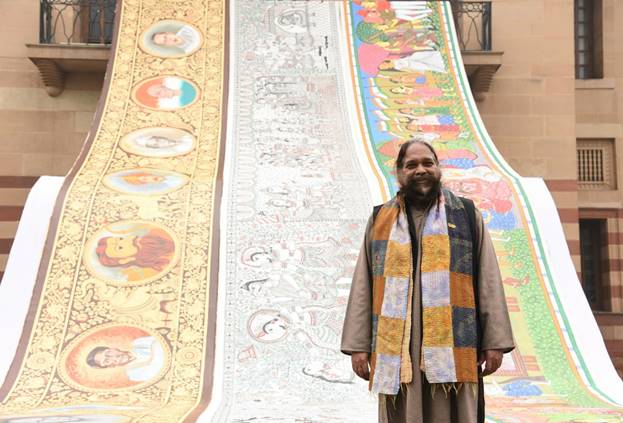
Image source : PIB
  • Shri Garanayak said, “The National Gallery of Modern Art, New Delhi has organised these workshops with the aim of amalgamating varied forms of visual and performing arts of the country to represent the true essence of unity and diversity in India. I believe that the gigantic scrolls when displayed at Rajpath will garner interest of each individual to delve deep into the history of the unsung heroes of India’s freedom struggle and would also draw attention towards the unified visual aspects of modern, indigenous and contemporary arts of India”.
  • At Odisha, the National Gallery of Modern Art, New Delhi collaborated with Kalinga Institute of Technology and Silicon Institute of Technology in Bhubaneswar from 11th – 17th December and at Chandigarh the collaboration was done with Chitkara University from 25th Dec 2021 – 2nd January 2022.
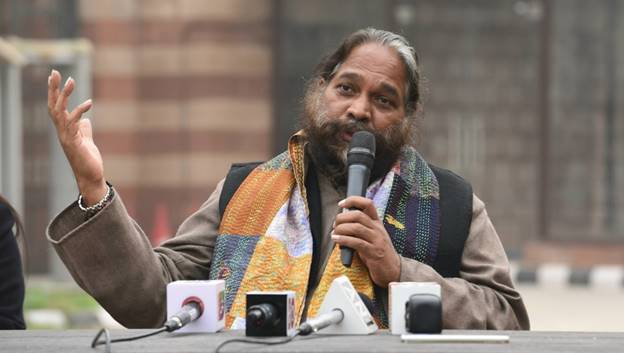
Image source : PIB
  • At Bhubaneswar, the narratives have reflected the tales of valor and historical elements of India’s movement of freedom struggle focusing on Odisha, Bihar, Jharkhand, Chhattisgarh, Bengal, north eastern parts of India and Andhra Pradesh with artistic expressions reflecting the indigenous forms of art such as Pattachitra, Talapatra Chitra, Manjusa, Madhubani and JaduPatua to name a few.
  • At Chandigarh, the narratives have been a reflection of the tales of valor of unsung heroes from Ladakh, Jammu, Kashmir, Uttar Pradesh, Delhi, Haryana, Punjab, Himachal Pradesh, Rajasthan with artistic expressions reflecting the indigenous forms of art such as Phad, Pichwai, Miniature, Kalamkari, Mandana, Thangka and Warli.
  • The closing ceremony of Kalakumbh- Azadi ka Amrit Mahotsav at Chandigarh was graced by Shri Banwari Lal Purohit, Governor of Punjab and Administrator of UT Chandigarh and at Bhubaneshwar by Hon’ble Member of Parliament, Dr. AchutyaSamanta who is also the founder of KIIT and KISS.
  • Several other dignitaries also evinced great interest in the scrolls during their visits to the workshops. Series of cultural programs were held in the evenings during these workshops, reflecting upon the rich traditions of folk and indigenous performing arts of India in collaboration with Eastern Zonal Cultural Centre and Northern Zonal Cultural Centre.
  • In the next phase, these scrolls will be placed artistically at Rajpath for the celebrations of Republic day, 2022.
  • The strategic location of these scrolls would serve as an open gallery for all the citizens and it is intended to inspire people about the rich national heritage and legacy of Bharat in its true sense.

Comments

Popular posts from this blog

Socio-Religious Movements and Organisations in India

 Welcome to Hanuman Studies, here are 12 Socio-Religious movements or organisations which happened/founded in India along with their Founder and Founding Year. Socio-Religious Movements in India (Hanuman STUDIES) These points are General Knowledge points which are asked in various competitive exams as various government sectors take tests to hire employee for them. These Socio-Religious movements or organisations are important for various competitive exams. Enjoy reading. हनुमान स्टडीज में आपका स्वागत है, यहां 12 सामाजिक-धार्मिक आंदोलन या संगठन हैं जो अपने संस्थापक और स्थापना वर्ष के साथ भारत में हुए/स्थापित हुए। ये बिंदु सामान्य ज्ञान के बिंदु हैं जो विभिन्न प्रतियोगी परीक्षाओं में पूछे जाते हैं क्योंकि विभिन्न सरकारी क्षेत्र अपने लिए कर्मचारी नियुक्त करने के लिए परीक्षण लेते हैं। ये सामाजिक-धार्मिक आंदोलन या संगठन विभिन्न प्रतियोगी परीक्षाओं के लिए महत्वपूर्ण हैं। मन लगाकर पढ़ाई करो। Socio-Religious Movements/Organisations in India Names are in the form of: S.no. - Movement/Organ...

Fundamental Rights in Indian Constitution (Articles 12–35) Complete Notes, Features, Writs & Amendments | 2026

Fundamental Rights in the Indian Constitution 📜– Complete Notes (Articles 12 to 35)  Fundamental Rights in Indian Constitution Complete Notes Articles 12 to 35 Explained 2026 Fundamental Rights are the heart and soul of the Indian Constitution ❤️. They guarantee essential freedoms to every citizen and protect individuals from arbitrary actions of the state. These rights are crucial for the overall development of personality and democracy . If you're preparing for SSC CGL, UPSC, or any government exam , this topic is extremely important 🔥. 🌟 What are Fundamental Rights? Fundamental Rights are basic human rights provided by the Constitution of India to all citizens. They are justiciable , meaning you can approach the court 🏛️ if these rights are violated. 👉 They are mentioned in Part III (Articles 12 to 35) of the Constitution. 🎯 Key Features of Fundamental Rights ✔️ Guaranteed by the Constitution ✔️ Enforceable by courts ⚖️ ✔️ Apply to citizens (some to non-citizens...

Jainism 70 Important Questions and Answers for SSC, UPSC and All Competitive Exams

 Jainism – 70 Important Questions & Answers Jainism 70 Important Questions Answers for Competitive Exams | Hanuman STUDIES 🔹 Basic Concepts Who was the founder of Jainism? 👉 Mahavira Who was the first Tirthankara of Jainism? 👉 Rishabhanatha How many Tirthankaras are there in Jainism? 👉 24 What is the real name of Mahavira? 👉 Vardhamana In which century did Mahavira live? 👉 6th century BCE 🔹 Birth & Life of Mahavira Where was Mahavira born? 👉 Kundagrama (Vaishali) Mahavira was born in which present-day state? 👉 Bihar Name the father of Mahavira. 👉 Siddhartha Name the mother of Mahavira. 👉 Trishala At what age did Mahavira renounce worldly life? 👉 30 years For how many years did Mahavira perform penance? 👉 12 years Where did Mahavira attain enlightenment (Kevalya)? 👉 Jrimbhikagrama What is the meaning of ‘Jina’? 👉 Conqueror Where did Mahavira attain Nirvana? 👉 Pavapuri Mahavira attained Nirvana in which state? 👉 Bihar 🔹 Core P...